DIY Boat Building
DIY Boat Building for Beginners: How to Choose and Build Your First Small Boat
Building your own small boat is a classic weekend-to-winter project: part woodworking, part puzzle, and very rewarding the first time it floats. This guide explains how to choose a realistic first design, how the main building methods compare, what materials and tools you need, and the safety steps that matter before launch day.
Free printable: Beginner Woodworking
Starter checklist: tools + your first 5 projects. Enter your email to get the PDF.
1. Start small: pick the right first boat
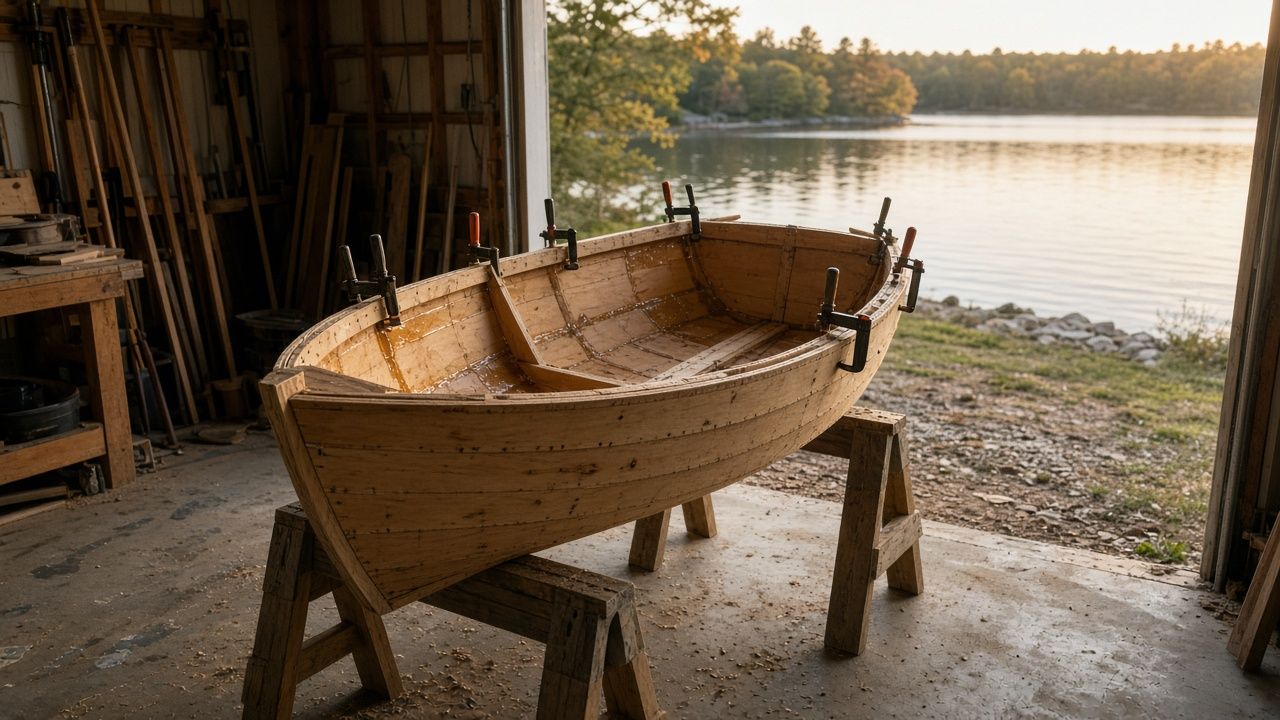
Building a boat is one of the most satisfying woodworking projects there is, and it is more achievable than most people think, if the first boat is small. A flat-bottomed pram, a simple rowing skiff, or a kayak or canoe under about 14 feet is a realistic first build for a garage.
- Use: rowing on a calm lake, fishing from a pond, or paddling a river? Match the hull to the water.
- Space: you need the boat's length plus about 3 feet all around to work.
- Transport: can you carry it on a roof rack, or will you need a trailer?
- Time: a simple plywood boat often takes a few weekends to a few months of evenings, depending on finish quality.
2. Build methods compared
Stitch-and-glue is the most beginner-friendly. Plywood panels are cut to shape, "stitched" together with wire or zip ties, then glued with thickened epoxy fillets and fiberglass tape. It needs few special tools and no building jig.
Frame (sawn-frame) construction builds a skeleton of frames on a strongback, then planks it. It is traditional and very strong, but takes more measuring and fitting.
Strip-planking uses thin cedar strips over forms, usually sheathed in fiberglass. It produces beautiful canoes and kayaks but is slower and more detail-oriented.
For a first boat, most builders recommend stitch-and-glue or a simple flat-bottom frame design.
3. Materials
- Plywood: marine-grade or a quality exterior plywood recommended by the plan. Voids in cheap plywood can let water in.
- Epoxy resin: a marine epoxy system with fillers (wood flour, silica) for fillets and glue.
- Fiberglass cloth and tape: to reinforce seams and protect the bottom.
- Fasteners: bronze or stainless steel; ordinary steel corrodes.
- Finish: marine primer and paint or varnish with UV protection.
Epoxy needs gloves, eye protection and good ventilation. Follow the manufacturer's mixing ratio exactly; guessing ruins batches.
If you want to browse a large library of boat designs with step-by-step instructions before you choose, there is a paid plans collection many hobby builders look at.
Disclosure: this is an affiliate link — if you buy, we may earn a commission at no extra cost to you. Learn more
Look at MyBoatPlans → (affiliate link)
4. Tools you need
A small boat can be built with ordinary shop tools: a jigsaw, circular saw, drill, block plane, random-orbit sander, clamps (lots), a long flexible batten for drawing curves, and plastic squeegees and mixing cups for epoxy. See our small shop setup guide for a basic tool kit.
5. A typical build sequence
- Loft the panels: transfer the plan's measurements onto plywood and connect the points with a batten.
- Cut and scarf: cut panels slightly oversize; join sheets end-to-end if the boat is longer than 8 feet.
- Stitch or frame: assemble the hull shape and check that it is straight and not twisted.
- Glue and fillet: apply thickened epoxy along every inside seam.
- Glass: tape the seams and, if the plan calls for it, sheath the bottom.
- Fit seats, gunwales and details.
- Fair, sand and finish: several coats of primer and paint or varnish.
Take your time with alignment early. A twist in the hull is easy to fix before glue and almost impossible after.
6. Reading a boat plan
A good plan includes a materials list, a table of offsets or full-size patterns, an assembly order, and the designer's rated capacity. Look for clear drawings and, ideally, photos of each stage. Stick to the plan's specified materials and do not change the hull shape; small changes can affect stability.
7. Safety, rules and launch day
- Check your local rules on registration and required equipment for small craft.
- Always wear a personal flotation device and carry what local rules require, such as a whistle or light.
- Test the boat in shallow, calm water near shore first, with a friend present.
- Respect the designer's capacity. Never overload a small boat.
Looking for a big library of boat plans?
MyBoatPlans (myboatplans.com, sold through ClickBank) is a digital collection of boat building plans and tutorials.
According to the vendor, it includes 518 illustrated, step-by-step boat plans and over 40 video tutorials, created by boat builder Martin Reid. Those are the seller's claims; plan quality can vary, and a boat's safety depends on careful building and following local boating rules.
Pros
- Large range of designs: canoes, kayaks, rowboats and more
- Step-by-step illustrations and videos per the vendor
- Lets you compare many designs before committing
Caveats
- A huge library can be overwhelming — pick one simple design
- Digital only; you supply materials and tools
- Order pages may show upsells you can decline
Affiliate link — we may earn a commission at no extra cost to you.
Disclosure & Privacy
This page contains affiliate links. If you buy through them we may earn a commission at no extra cost to you. Descriptions of MyBoatPlans repeat claims published on the vendor's own website; we have not independently verified them. This article is general information, not professional advice. SeeDIY is an independent publisher and is not affiliated with the vendor beyond the ClickBank affiliate program. Full details: Affiliate Disclosure, Privacy Policy, Cookie Policy, Terms of Use.
We do not sell your personal information. Hosting, DNS, and security run through Cloudflare Pages and Cloudflare. Questions: our contact form
Frequently asked questions
What is the easiest boat to build for a beginner?
A small flat-bottomed pram or skiff, or a stitch-and-glue kayak or canoe, is usually the easiest first build.
Can I use regular plywood for a boat?
Plans usually specify marine or high-quality exterior plywood. Cheaper plywood can have internal voids that trap water and rot.
How long does it take to build a small boat?
Often a few weekends to a few months of evenings, depending on the design, epoxy curing time and how fine a finish you want.
Free printable: Beginner Woodworking
Starter checklist: tools + your first 5 projects. Enter your email to get the PDF.