DIY Dog Agility
How to Build a DIY Dog Agility Course in Your Backyard (6 Easy Obstacles)
A homemade agility course is one of the most fun weekend projects for dog owners. It gives your dog a job, gets you both moving, and builds focus and teamwork. You do not need competition equipment: a few lengths of PVC pipe, a kids' play tunnel and one sturdy board are enough for six obstacles. This guide covers sizes, materials, a simple build for each obstacle and how to introduce them safely.
Free printable: Dog Brain Games
7-day enrichment checklist. Enter your email to get the PDF.
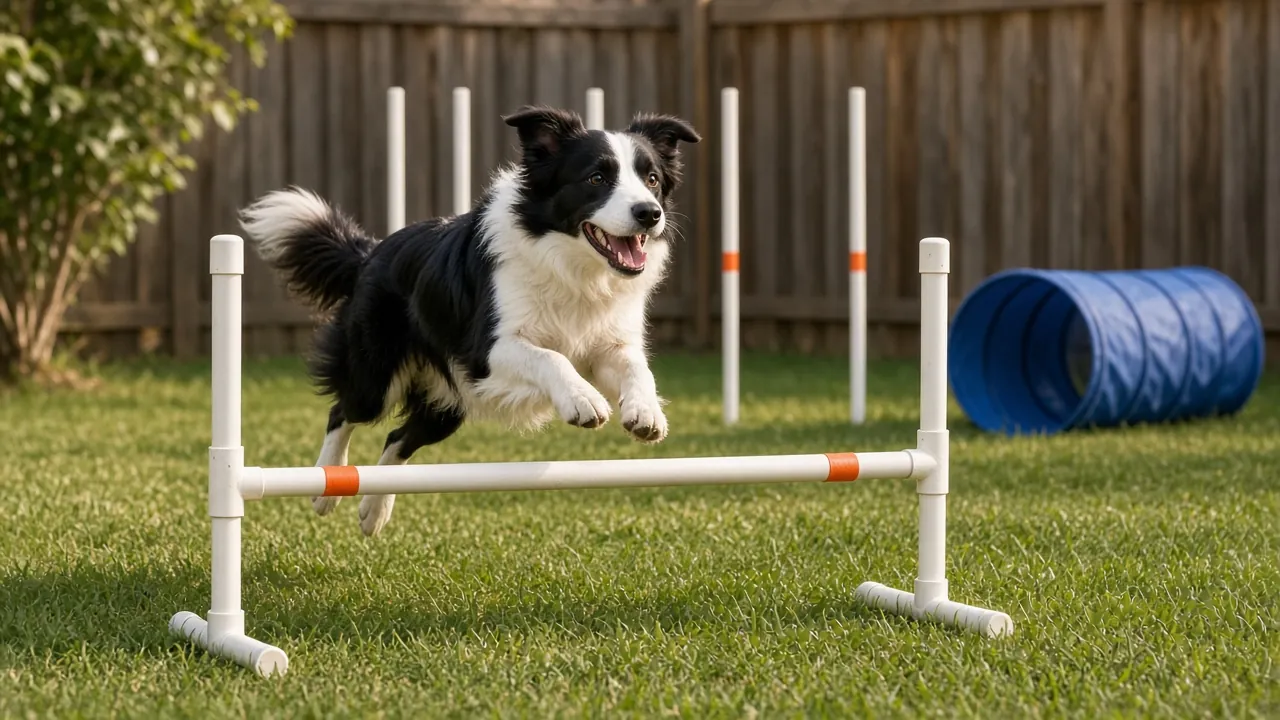
Before you build: is your dog ready?
Agility at home is about fun, fitness and teamwork, not speed. A few checks before you start keep it that way.
- Age and health. Young dogs can play with tunnels, a pause box and poles on the ground, but repeated jumping is hard on growing joints. Keep bars at ground level until your dog is fully grown, which is often around 12 to 18 months depending on breed. If your dog is older, overweight or has had joint problems, ask your vet which obstacles are a good idea.
- Basic manners. A reliable "sit," "wait" and recall make everything easier. If your dog cannot focus on you in the yard yet, spend a week on short focus games first.
- Surface. Flat grass is ideal. Avoid concrete for jumping, and check the lawn for holes, sprinkler heads and slippery spots.
- Weather. Train in the cooler part of the day and keep water nearby. Dogs overheat faster than people when they are excited.
Materials and tools
Almost the whole course is made from 1-inch Schedule 40 PVC pipe. It is cheap, light, weatherproof and easy to cut. You do not need glue for most parts: dry-fitted joints let you take obstacles apart, adjust them and store them in a garage corner.
- About six 10-foot lengths of 1-inch PVC pipe
- Fittings: roughly 12 tees, 8 elbows, 4 four-way crosses and 12 end caps
- A ratchet PVC cutter or a fine-tooth hand saw, plus a tape measure and marker
- Colored electrical or duct tape, so your dog can see bars and poles clearly
- A kids' play tunnel (about 6 to 9 feet long) and four tent stakes or U-shaped garden staples
- A plastic hula hoop and a few zip ties
- One 8-foot 2x10 board, two short 4x4 offcuts, exterior screws, exterior paint and a cup of clean sand
If your soil is soft, a few 12-inch lengths of rebar make excellent ground spikes for weave poles: hammer them in and slide the PVC poles over them.
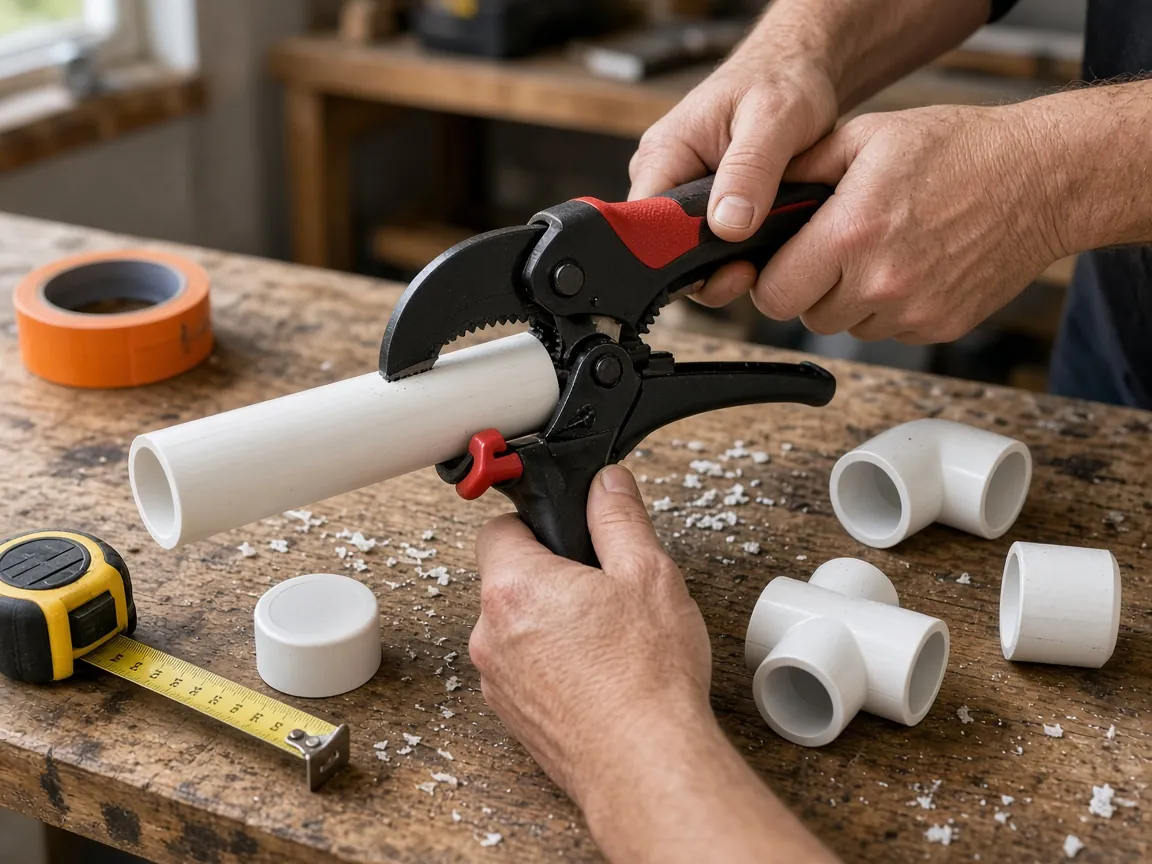
Obstacle 1: PVC bar jump
The bar jump is the easiest obstacle to build and the one your dog will probably love most.
- Cut two 36-inch uprights and four 12-inch feet. Push a tee onto the bottom of each upright and add two feet to each tee, so each upright stands on its own.
- Cut a 48-inch bar. Wrap it with two or three bands of colored tape.
- Make the bar holders: drill a hole through each upright every 4 inches and slide a short bolt or a large nail through at the height you want. The bar simply rests on top.
- The bar must fall off easily if your dog touches it. Never fix it in place, because a fixed bar can trip a dog.
Start with the bar lying on the ground between the uprights. Walk your dog through on a loose leash, reward on the far side, and only raise the bar a few inches once your dog trots through happily. For backyard fun, a bar at or below your dog's elbow height is plenty.
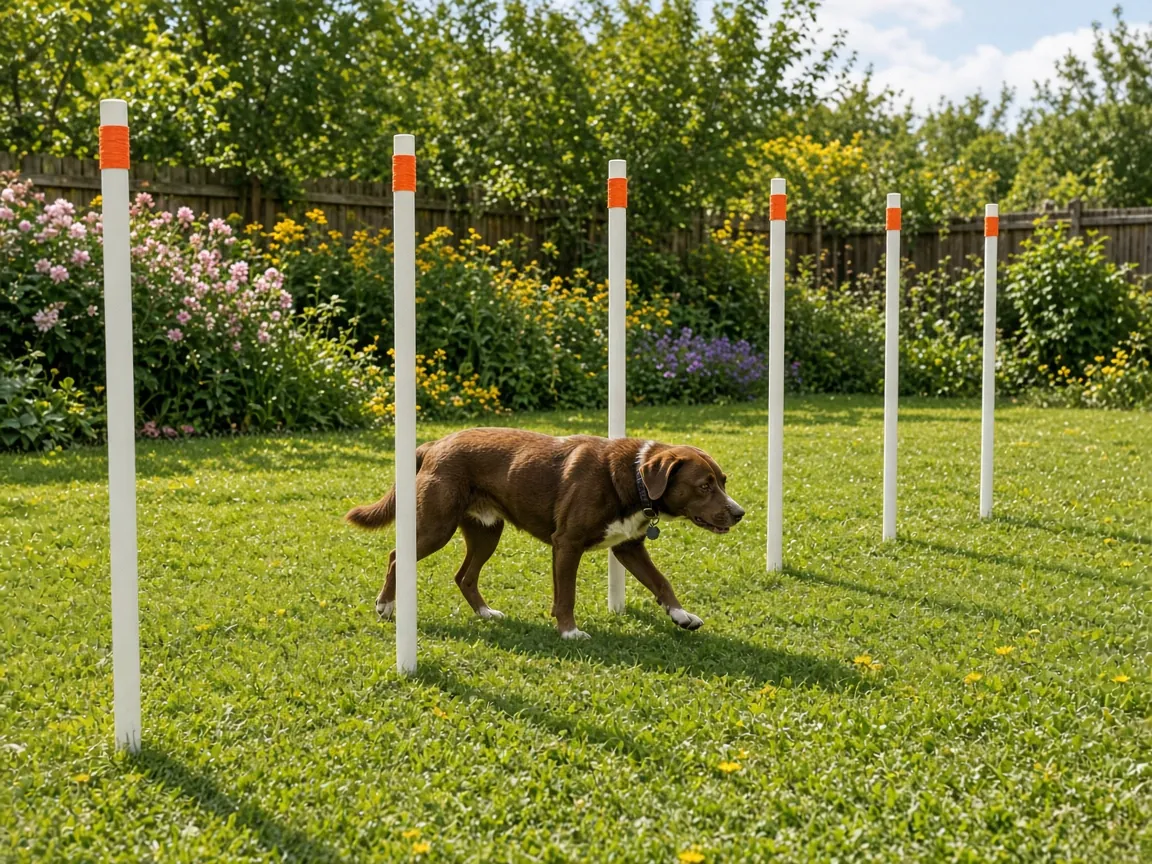
Obstacle 2: Weave poles
Weave poles look impressive, but they are a slow skill to teach, so build them early and practice in short bursts.
- Cut six poles, each 40 inches long, and wrap the top section with tape.
- Either push them over rebar spikes in the lawn, or build a base: a 10-foot pipe with tees spaced 24 inches apart, pointing up, and short cross-feet at each end for stability.
- Space the poles about 24 inches apart, center to center.
To teach weaving, start with a "channel": set the poles in two offset rows about a foot apart so your dog can walk straight down the middle for a treat. Over several sessions, move the rows closer until they form a single line and your dog is bending through. Always have your dog enter with the first pole at their left shoulder, which is the usual convention.
If your dog enjoys this kind of teamwork and you want a structured plan for focus, impulse control and basic obedience to go with your course, there are online programs built around short training games. This is one many dog owners look at.
Disclosure: this is an affiliate link — if you buy, we may earn a commission at no extra cost to you. Learn more
Look at Brain Training for Dogs → (affiliate link)
Obstacle 3: Tunnel
A kids' play tunnel works well for most small and medium dogs. For large breeds, look for a tunnel at least 24 inches in diameter.
- Lay the tunnel out straight and short at first. Many play tunnels can be scrunched to half length.
- Stake it down on both sides with tent stakes or garden staples so it cannot roll when your dog runs through.
- Have a helper hold your dog at one end while you kneel at the other, call your dog and reward the moment they come out.
Once your dog shoots through a short, straight tunnel, stretch it to full length, then add a gentle curve.
Obstacle 4: Pause box
The pause box teaches your dog to stop and settle in the middle of all the excitement, which is a great skill in everyday life too.
- Cut four 36-inch lengths of PVC and join them with four elbows to make a square on the ground.
- Lure your dog into the square, ask for a sit or down, count to two and reward.
- Slowly build the wait to five seconds, then release with a word like "okay" and run to the next obstacle together.
Obstacle 5: Hoop jump
- Build a frame like the bar jump uprights, joined at the top with a 36-inch crossbar.
- Hang a hula hoop inside the frame with two zip ties at the top and loose zip ties at the sides, so the hoop can swing and pop free if your dog bumps it.
- Start with the bottom of the hoop resting on the ground so your dog simply walks through it.
Raise it gradually, using the same height rule as the bar jump.
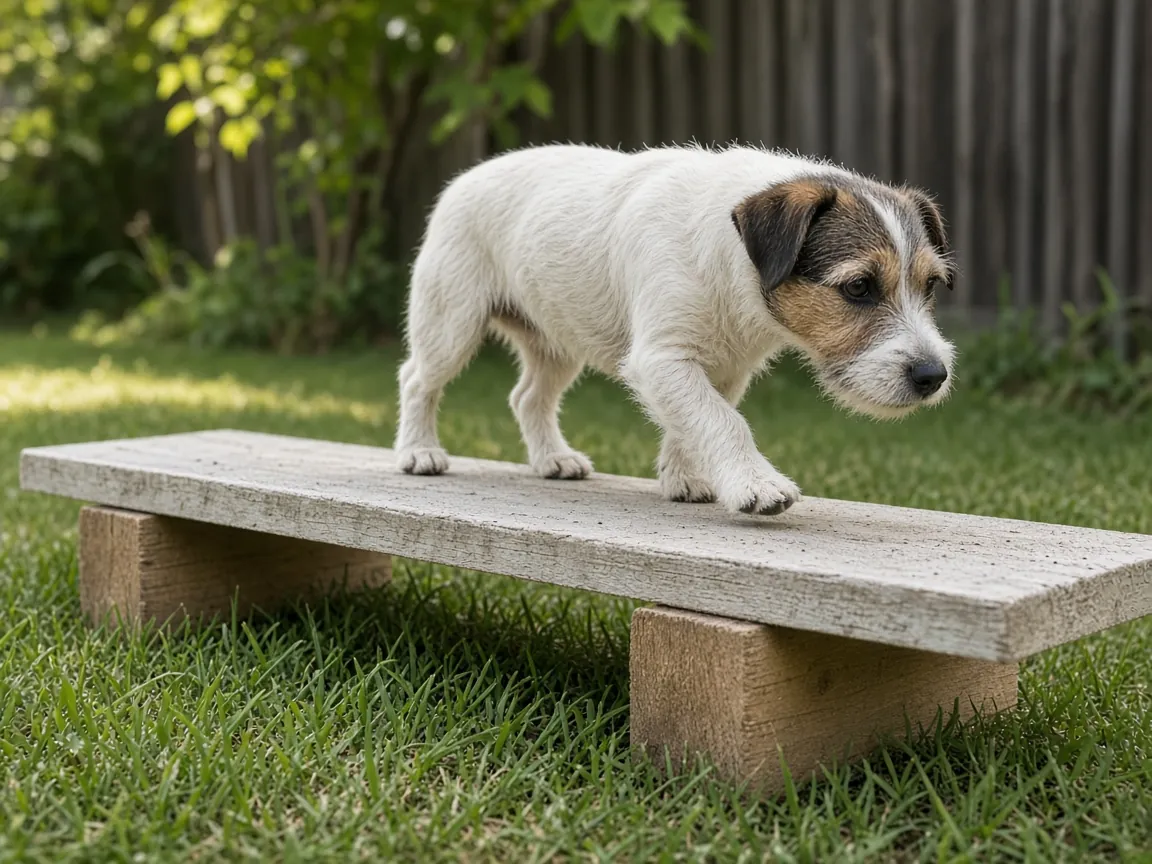
Obstacle 6: Low plank walk
A low plank builds balance and body awareness. Keep it low: confidence and good footing matter much more than height.
- Screw two 4x4 offcuts across the underside of the 2x10, about a foot in from each end, so the board sits roughly 4 inches off the ground and cannot rock.
- Paint the top with exterior paint and sprinkle sand into the wet paint for grip. Let it dry fully.
- Walk your dog along the plank on leash, feeding small treats every couple of steps, and help them step off at the end rather than jump.
Layout and your first sessions
Set the obstacles 10 to 15 feet apart in a loose figure eight or a gentle curve, not a straight line. Curves let you run beside your dog and change sides. A good beginner sequence is: tunnel, bar jump, pause box, hoop, plank, then the weave channel at the end when your dog is calm.
- One new obstacle per session. Teach each one on its own before you link two together.
- Five to ten minutes is enough. End while your dog still wants more.
- Reward generously. Small soft treats or a favorite toy at the end of each obstacle.
- No pressure. If your dog hesitates, make the obstacle easier instead of pushing or pulling them over it.
After a couple of weeks, most dogs can run a short sequence of three obstacles. That is the moment the course starts to feel like a real game for both of you.
Safety and maintenance
- Check every obstacle before each session: loose joints, cracked pipe, sharp cut ends and wobbly boards.
- Put end caps on all open pipe ends so your dog cannot catch a paw or a nose.
- Bars and hoops should always be able to fall or swing away.
- Skip jumping and the plank on wet grass or in hot weather.
- Take PVC parts inside over winter. Sunlight slowly makes PVC brittle, so replace any piece that cracks.
- Stop and call your vet if your dog limps, seems stiff after training or suddenly refuses an obstacle they used to enjoy.
Want a structured plan for focus and training games?
Brain Training for Dogs (braintraining4dogs.com, sold through ClickBank) is an online dog training course built around games and obedience lessons. It is not an agility course, but the skills it focuses on, like attention, stays and impulse control, are the same ones that make a backyard course safe and fun.
According to the vendor, it was created by a certified professional dog trainer, includes 21 games plus obedience lessons with videos, uses reward-based methods and is covered by a 60-day money-back guarantee. The sales page also says the method can fix almost any behavior problem; we have not verified that, results depend on the dog and on practice, and no course replaces a vet or an in-person professional for serious issues.
Pros
- Short, structured training games that fit around a backyard course
- Reward-based approach, per the vendor
- 60-day refund window as advertised by the seller
Caveats
- Not an agility program, so there are no obstacle plans
- Online only: you do the training yourself
- Order pages may show upsells you can decline
Affiliate link — we may earn a commission at no extra cost to you.
Disclosure & Privacy
This page contains affiliate links. If you buy through them we may earn a commission at no extra cost to you. Descriptions of Brain Training for Dogs repeat claims published on the vendor's own website; we have not independently verified them. This article is general information, not professional advice. SeeDIY is an independent publisher and is not affiliated with the vendor beyond the ClickBank affiliate program. Full details: Affiliate Disclosure, Privacy Policy, Cookie Policy, Terms of Use.
We do not sell your personal information. Hosting, DNS, and security run through Cloudflare Pages and Cloudflare. Questions: our contact form
Frequently asked questions
At what age can a dog start agility?
Puppies can learn tunnels, pause boxes and ground-level poles early. Keep jumps at ground or very low height until your dog is fully grown, often 12 to 18 months depending on breed, and ask your vet if you are unsure.
How high should a backyard agility jump be?
Start with the bar on the ground. For practice, many trainers keep jumps at or below elbow height, which is well under competition height and enough for fun and fitness.
How far apart should weave poles be?
About 24 inches center to center is the common standard. Use 6 poles for a home course and start with them offset into two lines so your dog can walk straight through.
How much space do I need?
A strip about 30 by 15 feet fits all six obstacles with 10 to 15 feet between them. A smaller yard works if you use three obstacles at a time.
Free printable: Dog Brain Games
7-day enrichment checklist. Enter your email to get the PDF.